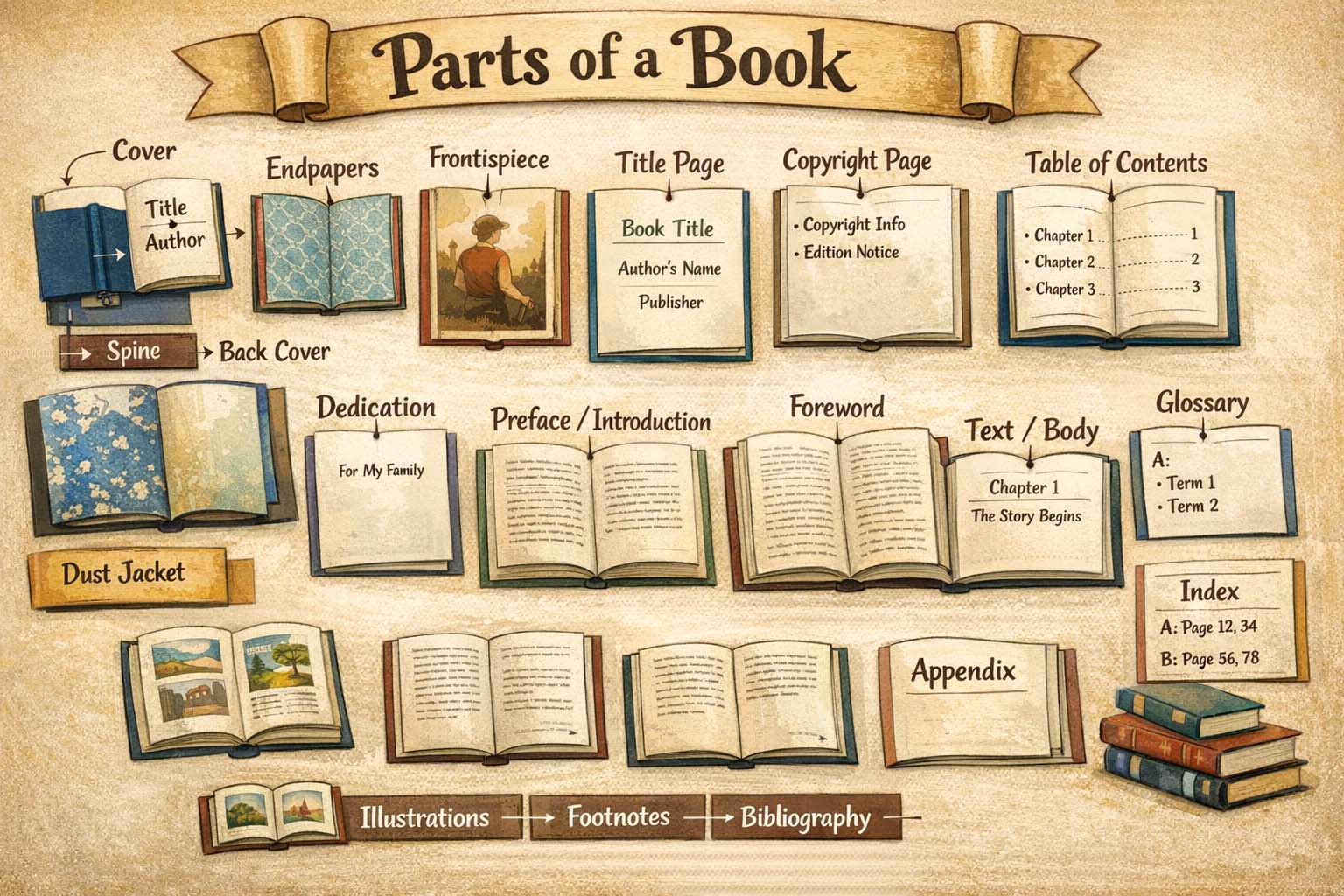
Understanding the parts of a book is helpful for students, writers, teachers, publishers, and readers. Every book is made up of several sections that organize content, provide useful information, and improve the reading experience. Some parts appear at the beginning, some form the main content, and others are placed at the end.
Books may vary depending on genre and purpose, but many share common elements. A textbook may include glossaries and indexes, while a novel may focus more on title pages and chapters. Knowing the structure of a book can help readers navigate pages and help writers create professional manuscripts.
This guide explains the main parts of a book in a clear and simple way.
What Are the Parts of a Book?
The parts of a book are the physical or written sections that make up the complete publication. main areas:
- Front matter
- Body matter
- Back matter
Each section serves a different purpose. Together, they help organize information and make reading easier.
Front Matter of a Book
Front matter includes the pages found at the beginning of a before the main text starts.
1. Cover
The cover is the outside protection of the . It includes the title, author name, artwork, and design elements.
2. Spine
book that usually displays the title and author name.
3. Title Page
The title page contains:
- Book title
- Subtitle (if any)
- Author name
- Publisher name
This is often the first printed page inside the book.
4. Copyright Page
The copyright page usually includes:
- Copyright notice
- Publication year
- Publisher details
- ISBN number
- Legal rights statement
5. Dedication Page
author honors a person or group.
6. Table of Contents
The table of contents lists chapters or sections with page numbers. It is especially useful in nonfiction books.
7. Preface
A preface is written by the author and explains why the book was written or how to use it.
8. Foreword
than the author, often praising or introducing the work.
9. Introduction
The introduction gives readers an overview of what to expect.
Body Matter of a Book
Body matter is the main content of the book. This is where the core story, information, or lessons appear.
1. Chapters
Chapters divide content into organized sections. Fiction and nonfiction books often use chapters.
2. Parts or Sections
Longer books may group chapters into larger sections called parts.
3. Main Text
This includes paragraphs, stories, lessons, arguments, examples, or dialogue depending on the type of book.
4. Illustrations or Images
Some books contain diagrams, drawings, photos, or charts to support the content.
5. Headings and Subheadings
Nonfiction books often use headings to organize topics clearly.
Back Matter of a Book
Back matter includes pages found after the main text.
1. Epilogue
An epilogue gives additional closure after the main story ends, common in novels.
2. Afterword
The afterword may include final thoughts, updates, or reflections.
3. Glossary
A glossary explains difficult words or technical terms.
4. Appendix
An appendix contains extra supporting material such as charts, data, or references.
5. Notes
Some books include footnotes or endnotes for citations and explanations.
6. Bibliography
A bibliography lists sources used in research or writing.
7. Index
by page number.
8. About the Author
Many books include a short biography of the author.
Why the Parts of a Book Matter
Each section improves the reading experience.
Benefits Include:
- Better organization
- Easy navigation
- Professional presentation
- Helpful references
- Reader understanding
- Stronger credibility
Without structure, books would be harder to read and use.
Parts of a Fiction Book
Fiction books often focus on storytelling elements.
Common Fiction Parts:
- Cover
- Title page
- Dedication
- Chapters
- Prologue
- Main story
- Epilogue
- Author bio
Novels may not always need indexes or glossaries.
Parts of a Nonfiction Book
Nonfiction books often prioritize organization and reference tools.
Common Nonfiction Parts:
- Table of contents
- Introduction
- Chapters
- Headings
- Charts
- Glossary
- Notes
- Index
These parts help readers learn efficiently.
Parts of a Textbook
Textbooks are designed for education.
Often Include:
- Table of contents
- Learning objectives
- Chapters
- Diagrams
- Review questions
- Glossary
- Index
- References
Textbooks are usually highly structured for study purposes.
Parts of a Children’s Book
Children’s books may use simpler formats.
Common Elements:
- Bright cover
- Title page
- Illustrations
- Short text
- Story pages
- Author page
Visual design is especially important in children’s books.
How Writers Use Book Structure
Writers use book parts to create a professional reading experience.
Smart Uses:
- Title page for branding
- Contents for navigation
- Chapters for pacing
- Glossary for clarity
- Index for usability
Strong structure can improve reader satisfaction.
Common Questions
Does every book have all parts?
No. Different books include different sections depending on purpose and genre.
What are the three main divisions?
What is the most important part?
The main text is central, but organization matters too.
Do novels need a table of contents?
Some do, but many novels skip it.
Tips for Self-Publishing Authors
If you are publishing a book, consider including:
- Attractive cover
- Clear title page
- Copyright page
- Organized chapters
- Author bio
- Professional formatting
These details make books look polished and trustworthy.
Digital Books vs Printed Books
Ebooks still use many traditional parts of a book, though navigation may be digital.
Examples:
- Clickable table of contents
- Digital chapters
- Hyperlinked notes
- Search instead of index in some cases
Book structure remains important even online.
Conclusion
Learning the parts of a book helps readers understand how books are organized and helps writers create stronger publications. From the front matter like title pages and contents, to the body with chapters and main text, to the back matter with glossaries and indexes, each section serves a purpose.